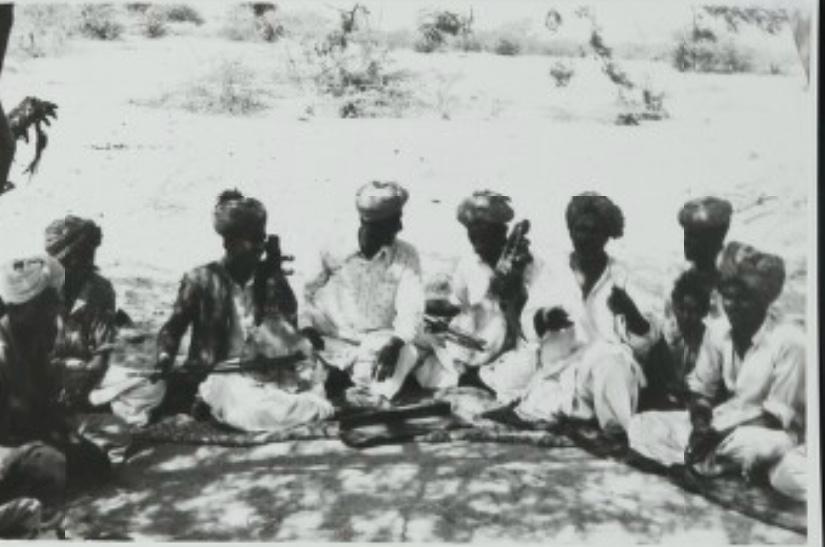
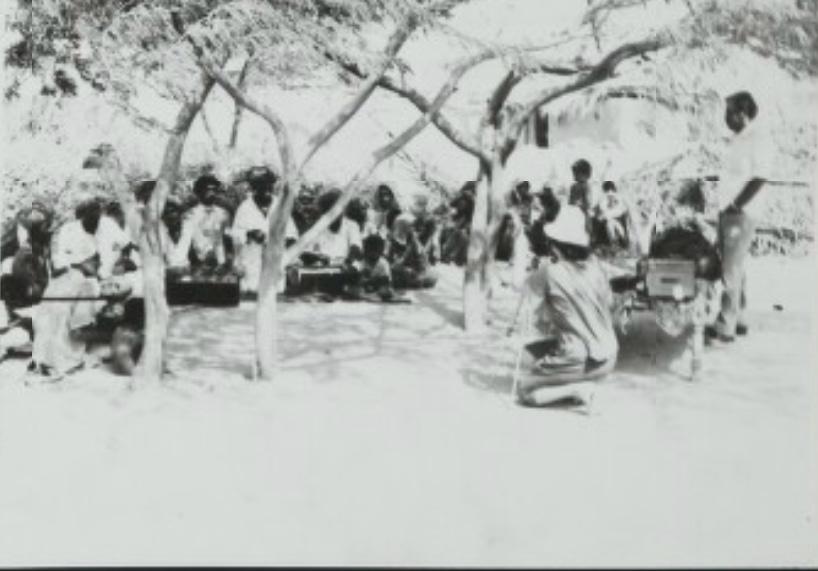
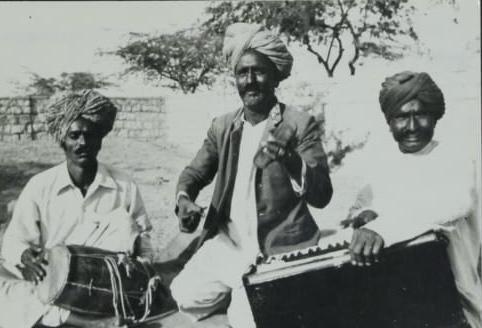
The musical heritage of Firoz Khan Manganiyar rests upon a lineage of towering maestros whose artistry shaped the soundscape of Rajasthan’s folk and classical traditions. Each generation did not merely preserve music — they expanded its vocabulary, leaving behind innovations that continue to resonate today.
Ustad Nihal Khan Sahib stands as one of the earliest Manganiyar musicians to bring classical discipline into a predominantly folk tradition. At a time when Manganiyar music was largely oral and regionally bound, he possessed rare and profound knowledge of raag–ragini, taal vidya, and classical structure.
His command over classical aesthetics elevated the musical status of the Manganiyar community in the Barmer–Jaisalmer region, bridging folk expression with classical refinement. He laid the intellectual and spiritual foundation upon which future generations would innovate, making him a cornerstone of this lineage.
Ustad Sadik Khan Sahib made an extraordinary and historic contribution to Indian folk music by creating the Kartaal (Khartaal) — an instrument that would go on to become the rhythmic signature of Manganiyar music and Rajasthani folk heritage.
More than an instrument maker, he was a visionary. He designed the form, developed the playing techniques, and established the taal structures that define Kartaal performance today. What the world now recognizes as Kartaal rhythm is, in essence, his musical imagination brought to life.
His legacy lives on every time Kartaal is played — not as an accessory, but as a commanding rhythmic voice.
Ustad Rana Khan Sahib, also known as Ramjan Khan, was a master dholak player whose influence transformed rhythmic traditions across Rajasthan. Trained formally in Sindh, he was the first musician to introduce the “tirkīt” style of dholak playing into Rajasthan — a technique that added speed, complexity, and expressive depth to folk rhythm.
His playing was known for its precision, power, and inventiveness. Over time, his name became synonymous with excellence in dholak performance, and his rhythmic ideas continue to form the backbone of Manganiyar percussion practices today.
Ustad Gaffur Khan Manganiyar is among the most revered figures in contemporary Manganiyar music. A master folk vocalist and Kartaal exponent, he is respected across Rajasthan simply as “Ustad” — a title earned through decades of devotion, discipline, and teaching.
He has trained over 500 disciples, ensuring the continuity of traditional Manganiyar repertoire and Kartaal technique. His ability to balance vocal expression with intricate Kartaal rhythm set new benchmarks for performance.
In recognition of his lifelong contribution to Indian folk music, he was honored with the National Award in 2020 by the President of India — a moment of pride not just for his family, but for the entire Manganiyar community.
Ustad Safi Khan Sahib was a rhythmic prodigy whose brilliance earned him the title “Badshah of Dholak.” At a remarkably young age, his mastery brought him national and international recognition.
In 1995, he achieved the rare honor of accompanying Ustad Zakir Hussain in performance — a testament to his exceptional skill and musical stature. Tragically, just a month later, his life was cut short in a road accident during a tour in France.
Though his time was brief, his innovative rhythmic compositions and patterns remain deeply embedded in the family’s musical practice, continuing to inspire and guide future generations.
Together, these maestros formed not just a family, but a musical institution. Their collective contributions shaped instruments, techniques, rhythms, and philosophies that define Manganiyar music today.
Firoz Khan Manganiyar carries this lineage forward — not as history, but as living sound. In his hands, the wisdom of generations continues to evolve, ensuring that the rhythm of the desert never fades — only transforms.